
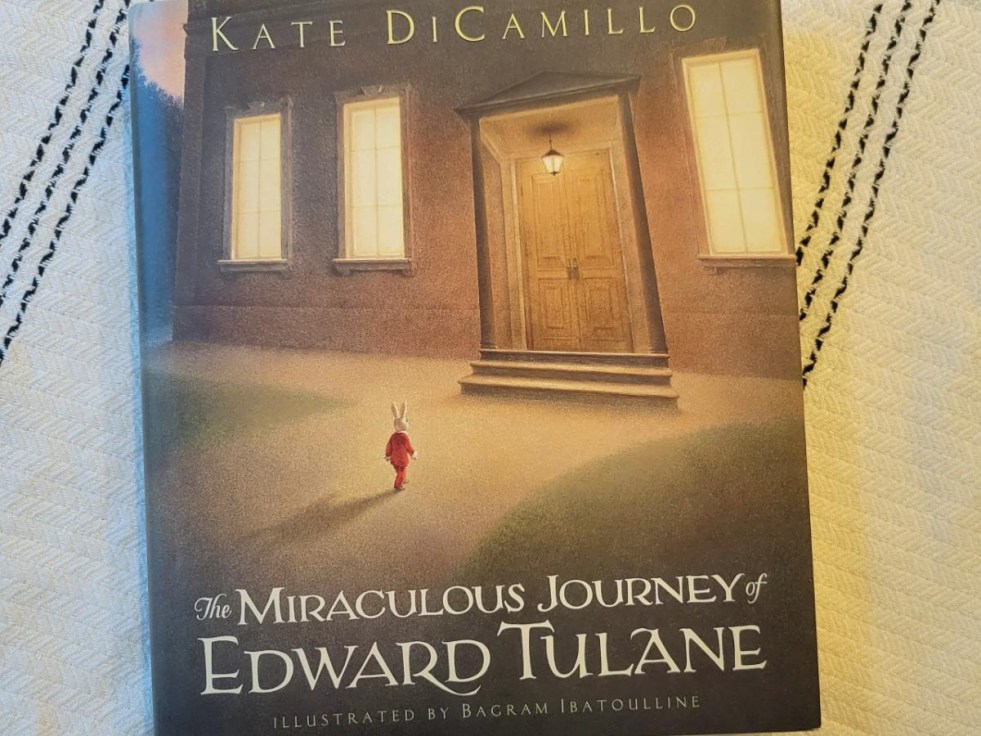
I recently read this book for the first time and loved it! I’m excited to talk about some of the beautiful things I see illustrated in The Miraculous Journey of Edward Tulane. It’s a wonderful story, and as soon as I read the first chapter I had a feeling it would be used for a blog post soon. 🙂
It seems that I’m always uncovering new wonders by Kate DiCamillo that I had heard of but hadn’t taken the time to enjoy. I am a big fan of her writing (a while ago I even wrote a post about her book, The Tale of Despereaux). This book is very distinctly a work of hers. She doesn’t waste words, but uses each one to tell a story of suffering and hope.
Because her stories are so clear, there are always beautiful lessons and morals to take out of her books. As a rule, I don’t like to turn stories into lessons (they lose so much of their worth and value that way), but Kate DiCamillo’s books brim with these morals and illustrations in a way that most don’t. The stories are the morals, and that is why to discuss themes of hope and love found in her writing is to discuss the story.
The Book
The Miraculous Journey of Edward Tulane is a very nice looking book with illustrations for each chapter and an elegant, satisfying cover. My copy is a hardback with pretty wallpaper-like front pages and several colored pictures throughout. It’s the sort of book that has you itching to read it just by looking at it, the sort you’re sure will hold just as good a story as its appearance.
It wasn’t misleading me. This is the charming story of a china rabbit who is the prized possession of a little girl named Abilene. She dresses him each day and brings him to the dinner table with her each night. She loves him with all the love a girl can have for her rabbit, but Edward, in all his grandeur and pride, does not return an ounce of that love back to her. He doesn’t even realize what her love for him means until it is too late.
On a boat trip there is an accident and Edward flies overboard. Now he is lost. He no longer cherished and adored. He is lonely, dirty, and unloved. But in his wandering he meets new people, and, lo and behold, he learns to love for himself. But loving hurts, because over and over again he is torn away from people he has grown to love.
It is a simply written, lovely story about a rabbit who finds that not only is it possible to love others, but it is possible to lose that love and still love again.
Names
There is a quote in this book that stood out to me while I was reading. And that quote is this:
Edward felt a weariness so intense wash over him that he thought he might actually be able to sigh aloud. Would the world never tire of calling him by the wrong name?
-p. 111
This quote comes after Edward is lost and found by yet another person who does not know Edward’s real name, and calls him by whatever she chooses. It was an almost profound moment that I felt was one of the best in the book.
Edward has been called by something that is not his name many times. People no longer remember who he is. A name is a special thing. It is something that every person has, and when you are called by it it means that someone knows you, at least a little bit. That’s a very reassuring thing.
I can’t help but think of it in regards to the names Christ calls us as Christians. While the devil labels us with lies, He gives us names such as Loved, Chosen, Friend. The names that Jesus calls us are what forms our idendity.
But poor Edward is learning what it’s like not to be known or loved. His name has been forgotten. But he has not lost it forever.
I love the journey Edward takes not only in body, but also in heart. Throughout the book he loses his identity, and then finds it again in a new, more tender way.
Final Thoughts
This book may be my new favorite of Kate DiCamillo’s! It is charming, amusing, and so rewarding to finish. The characters are unique, the story is intriguing, and the ending is full of all the satisfaction you would expect from this sort of story.
Have you ever read The Miraculous Journey of Edward Tulane before?Do you have a favorite scene? Let’s discuss it in the comments!

 For the Love of Stories