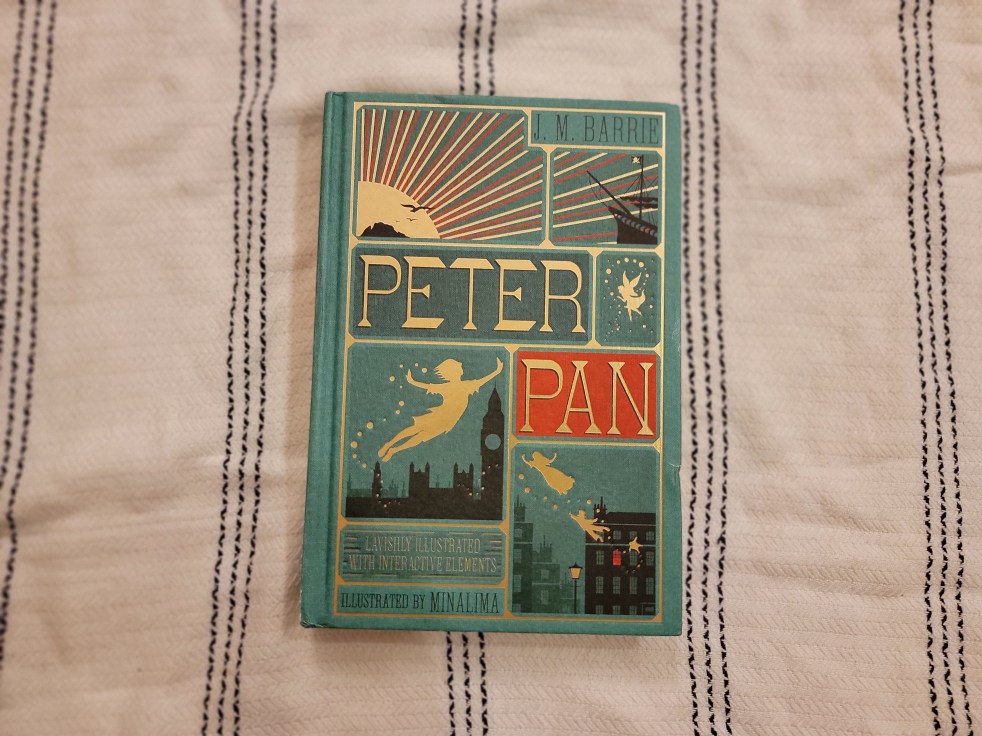
Peter Pan is one of those stories that I loved more and more every time I read it. I think that most people are familiar with it. A boy comes to the home of three children and teaches them to fly off to Neverland, where they face many fantastic adventures and incredible dangers. It is a classic story that is special to many people.
When I was reading it recently I couldn’t help but admire the many concepts of childhood that are so beautifully displayed in the book. For such a gem of a book I wish more people have read and appreciated it for all its worth. In this post I’m going to take some time to dive deeper into a few of the concepts found in this unique story.
The Movie vs. the Book
The first time I was exposed to the story of Peter Pan was through the classic Disney movie. Oddly enough, I never read the book until a few years ago, when I listened to it on audio. I have always loved the movie, but the book struck a totally new cord. The movie was delightfully sweet and maybe possibly sentimental, but the book is heavily bittersweet and reflective.
As a child I enjoyed the adventures told in the movie just as much as in other movies. It was so much fun to see the children fly off to Neverland with the intriguing Peter Pan and Tinkerbell. These same adventures all appear in the book as well, as the two versions are very similar, but there are also differences.
Peter Pan, for example, is so vividly portrayed as a child in the books, and all of his actions and triumph are clearly shown through the mindset of a young boy. You see his innocence, his pride, his playfulness, and the way he is drawn to heroism and victory. The story is greatly influenced by these details, and that is one of the most significant details between the book and the movie. While in the movie you can see and be enthralled by the action, it’s the book that pauses to let you in on the small secrets that make the story so special.
The Importance of Mothers
A recurring theme throughout the story is the question of mothers. What exactly is a mother? Peter doesn’t really know, but he takes Wendy off to be one of his very own, despite his dislike for them in general. And so Wendy becomes the mother of not only him, but also all of the lost boys, and even her own John and Micheal. Even the pirate Smee wants her for his own mother (though of course she refuses).
Wendy makes a beautiful mother for a time. She remembers their medicine, puts them to bed at a proper time each evening, and patches all of their many clothes. But when her brothers show signs that they have forgotten about their dear, real mother, she begins to see the sadness of the situation.
When at long last the children return to their home Wendy is tempted still to go off to Neverland and keep on acting as mother to Peter. She pleads with her mother, explaining how he does so needs a Mother. But Mrs. Darling responds tenderly with the words, “So do you, my love.”
Never Growing Up
Everyone knows that Peter Pan is the boy who never grows up. Not only do boys on Neverland stay young forever, Peter Pan doesn’t even want to get older. He is completely against the whole thing, and finds great fault in grown ups for giving up their childhood.
It might seem like by the end of the book he will have changed his mind. That by the time Wendy, and John, and Micheal decide to leave Neverland he will join them, and leave his childhood behind him as everyone else does. But he doesn’t. Even when Wendy is grown up and has a girl of her own Peter stubbornly refuses to do the same. Yet he comes back from time to time, taking back with him to Neverland Wendy’s daughter, and then her daughter’s daughter, to be his mother for a time and tell him stories of himself.
And that is how the story comes to a close. Peter Pan is still a boy, and so he will continue to be forever as long as children continue to be children.
Final Thoughts
There is something eternally sincere about the story of Peter Pan that will continue to affect me however long I read the book. It makes my heart ache in a way, and I’m not quite sure what it’s from. Is it the presence of childhood displayed in the book and fills me with bittersweet pleasure? Is it the end of childhood shown when the story is over and fills me with a strange sadness? Or is it even the childhood that Peter will live forever that fills me with an inexplainable sense of wrong?
I don’t know exactly what it is about this story that I love so much, but it becomes more and more dear to me every time I read it. Have you read it before? What are your thoughts on the concepts of the story?

 For the Love of Stories
I actually might need to read the original Peter Pan soon… I just started Dust by Kara Swanson, and it’s been so riveting from the very beginning, but I think it would be helpful to read the original material she’s pulling from.
LikeLike
I actually just started it as well! I’m very interested to keep reading it.
LikeLiked by 1 person
Just wrapped it up yesterday. It was such a fun fantasy read, and I really loved Swanson’s personification of Peter Pan. After reading reviews, though, I don’t think I’ll read Shadow. It sounds a bit gruesome for my taste.
LikeLike
I have never actually read the book, which is odd as I have grown up on the movies and I always loved the thought of going to Neverland when I was younger. I think Peter Pan will be on my reading list now! 😊
LikeLike
Ah, yes, the movie is delightful. I hope you enjoy reading it as well!
LikeLiked by 1 person
I’ve only seen the animated movie (and live action variations of it too. I especially enjoyed the movie about J.M Barrie’s life and what inspired him to write about Peter Pan.) Now I’m adding the official book to my TBR!
LikeLike
Yay! I hope you find it enjoyable!
LikeLiked by 1 person